Showing posts with label wikibeadia. Show all posts

Wednesday, July 22, 2009

Wikibeadia: Filigree

Art Bead Scene loves filigree but we've never defined it and done a Wikibeadia post on it. So we're going to rectify that today!

According to wiseGEEK

"Filigree refers to the process and type of design that uses twisted wire to create delicate, lacy, openwork jewelry. Usually made from finer metals like gold, silver and platinum, filigree has been used for centuries to craft jewelry such as pins, rings and pendants. To create filigree, an artisan rolls the malleable metal into thin filaments, then twists and bends them into intricate shapes that resemble spun sugar, paisley scrolls and evocative arabesques."

Last fall's ABS monthly challenge was filigree and here are a few of the submissions to show off and a free filigree project...

Empress by jewelsbydesign:


Autumn Cascade by ABS Editor, Heather Powers:


An Art Noveau-Inspired Pendant free project from ABS Editor, Cindy Gimbrone:

Thursday, March 5, 2009

Wikibeadia - Shibuichi

Shibuichi - the word means "one-fourth" in japanese, which refers to the proportions of one part silver to three parts copper. This clasp is from Green Girls Studio in shibuichi, cast in the alloy of copper and silver.


Because of the increased copper in the alloy, shibuichi has a lovely patina ability to grant great colors of blue and green. This toggle set is from Zoa Arts in shibuichi silver.

Posted by Lynn Davis, who loves to patina silver and copper.

Thursday, October 23, 2008

Wikibeadia: Mosaic Style Jewelry


I have a long history of prowling garage sales, flea markets and antique shops for jewelry and junk to use in jewelry. I've picked up several pieces of Italian made mosaic jewelry. Small "tiles" made of shell, coral, turquoise and other natural materials are arranged in a pattern or a scene. Micro Mosaic uses smaller tiles so the pattern is smoother like in this museum quality micro mosaic brooch:


Naama Zamir, a polymer clay artist posted a photo of a modern mosaic art pendant she created on her blog:

Whether old or new, mosaics offer a unique design technique to incorporate into your art jewelry.

Writen by Cindy Gimbrone mosaic jewelry lover and glass beadmaker.

Thursday, September 11, 2008

Wikibeadia: Anodized Aluminum

The bright cheery colors of anodized aluminum is created by dyeing. Before aluminum can be dyed, it is corroded (or rusted) through an electrical process. The corrosion actually makes the aluminum stronger. Then the aluminum is dyed and sealed so the color doesn't bleed out of the metal.

Tari of Clay Buttons incorporates bright colors in her work and the anodized aluminum jump rings make a vibrant keyring.


Color shouts at you to vote in these colorful pins from Hsu Studios.


Or it can be used in a subdued, classic way as in the Share Your Heart necklace.


Written by Cindy Gimbrone, lover of anodized aluminum and glass beadmaker.

Thursday, September 4, 2008

Wikibeadia: Mokume Gane with Polymer Clay

Wikibeadia: Mokume Gane

Mokume Gane (pronounced moe-koo-may-GAHN-ay) is a Japanese metalworking technique. In Japanese metalworking, several types of metal are layered and worked together to form a wood grain type of pattern, usually with silver, gold and alloys of metals.

The technique has been adopted with polymer clay for making art beads using stacks of colored clay that are pierced or stamped and then thin layers are sliced off revealing the bold patterns. Mokume gane often gives a very abstract pattern to the beads with graphic and linear designs. This strand of Tucson beads by Pam Wynn is a great example of mokume gane.

If you admire graphic linear designs, in tones of gray or layers of color, look for art beads made using the mokume gane technique.
Other polymer clay beads artists offering mokume gane beads:

Tuesday, August 12, 2008

Wikibeadia: Frit

( Frit Implosion Pendant by Emmetsglass on Etsy)

Dictionary:
frit
(frĭt) pronunciation

n.

1. The fused or partially fused materials used in making glass.
2. A vitreous substance used in making porcelain, glazes, or enamels.

tr.v., frit·ted, frit·ting, frits

In the art glass world of beadmaking, frit is an obsession for some, a business for others.

Val Cox started the craze with her furnance glass frit. Who could resist wanting to make beads as lovely as her frit beads below?


(Photos Credits: Val Cox beads

Frit is used by all types of artists whether you blow glass, melt glass at a torch or fuse glass.

Hot glass is either rolled into the frit or the frit is applied to the glass and melted into the glass in a kiln. Frit opens up a wide range of design and color possibilities for the creative glass artist.

Written by Cindy Gimbrone, glass beadmaker - a frit lover herself!

Tuesday, July 29, 2008

Wikibeadia: Kiln Annealed?


(Flameworked glass beads by Cindy Gimbrone)


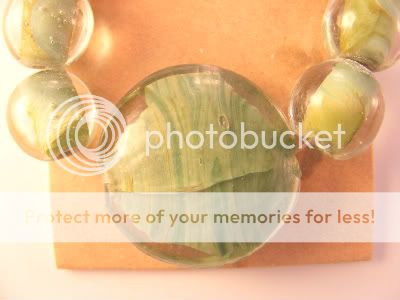
(Fused glass gem by Lynn Davis)


When buying glass beads and/or fused glass one important feature handmade glass art beads typically have that craft store beads don't have is artists will kiln anneal their glass beads.

Why should you care about kiln annealing? Kiln annealing strengthens glass by allowing the glass to cool very, very, very slowly. If properly done, it relieves any stress in the glass and the beads won't crack.

Below is a picture of a set of glass beads I purchased at a local craft store:


As a glass beadmaker, I know by where the crack is, that the bead has not been kiln annealed. A crack along the bead hole means the glass cooled too quickly. Glass cools too quickly when it hasn't been placed in a heated kiln.

Here's a picture of me placing a hot glass bead into my heated kiln to anneal. Notice the temperature on the kiln reads 968 Fahrenheit, the proper temperature to anneal soda lime glass. (Ignore the hat and sweatshirt, it was the winter and my studio is unheated.) My kiln has an automatic cut off switch so when I open it, the electricity to the kiln shuts off. An important safety feature as are my safety glasses, my kevlar gloves and leather apron.


Did you know a properly annealed glass bead will bounce rather than break when dropped on the floor? Although I don't recommend you start dribbling your glass beads, I have dropped them on my concrete floor by accident and they do bounce.

So when buying art glass beads, check to for the words "kiln annealed" to ensure your treasure will last a lifetime.

Written by Cindy Gimbrone, glass beadmaker, who's accidentally bounced many beads off her studio floor.

Thursday, July 24, 2008

Wikibeadia - Silver Metal Clay

Wikibeadia - Silver Metal Clay - Unique Silver Art Beads and Findings

Silver metal clay is created from fine particles of silver suspended in an organic binder. When it's fired in a kiln, the binder burns away and the silver bonds together, creating a shape in fine silver. The technology of the material was developed in Japan in the early 1990's, based on an idea that came from the japanese tradition of using ceramic clay to form and fire shapes, and a desire to translate the ability to form shapes and have finished silver jewelry pieces that were shaped in the same way as ceramic clay is shaped and fired.


Silver metal clay is plastic and versatile, and in its wet state it can be folded, molded, extruded and rolled just like clay. When dry, it can be carved, textured and assembled into three-dimensional objects like boxes and lockets.

What is silver metal clay? The silver particles are microscopic and slide freely in the binder, but fuse together into a solid piece of silver in the kiln.


For the adventurous, there is also gold precious metal clay that fuses to nearly pure gold, and it's so beautiful but, just like the real gold it's made from, it is expensive.

Boxes, headpins, clasps and links for chain made with silver or gold metal clay have gorgeous texture and, if they are strengthened properly by hammering or work hardening, create functional and beautiful accessories to use in your beading designs.

What should you watch for when buying silver metal clay art beads and components? Look for sturdy, dense pieces of silver, and if they are structural components like clasps or chain links, look for signs that they have been hammered to harden them. If you can easily bend them with your fingers, or if there are cracks around the edges of the silver, they may not have been fired long enough or work hardened after firing. You need for them to hold up in your jewelry designs to heavy wear and to last without stress fractures or soft spots forming.

I love the idea of creating jewelry findings and accents out of fine silver to combine with other art beads, that silver bling adds that special bit of zing!

Written by Lynn Davis who fires anything that will fit in the kiln and take the heat

Tuesday, July 15, 2008

Wikibeadia: Borosilicate Glass Beads

We love borosilicate or "boro" glass beads for the muted colors they display. Yet what exactly is borosilicate glass?

Borosilicate glass was invented by Otto Schott in the 19th century and sold under the name "Duran" in 1893. Corning Glass began to market borosilicate glass under the name "Pyrex" around 1915. Borosilicate has a higher melting temperature and therefore can withstand wide variations in temperature.

Modern flamework artists are taking borosilicate glass to new levels far beyond what the creators imagined. Since boro glass can withstand wider variations in temperature, it is particularly suited to sculpture. Some wonderful examples of sculptural beads in borosilicate are these "exotic shells and ammonites" made by Jeremy Sinkus. (Photos from Jeremy's website)


The muted, swirling colors of boro glass enhance the organic subject of the art beads. Jeremy is one of many artists who create lovely boro beads. Others artist work with frit to create lovely beads in boro and soda lime glass. Look for another Wikibeadia post on frit!

Written by Cindy Gimbrone, glass beadmaker and dabbler in borosilicate glass.

Sunday, June 17, 2007

Wikibeadia: Palchemy


Here is a new word to me: Palchemy
Dawn Chastain left a comment on my blog about using the process of elimination. This caught my attention so then I clicked on her name which lead me to her Etsy store. As I read the description of the listed item I see the word "Palchemy" ... I love words so this was intriguing to me. Here is what I have found posted by lilikoi on Etsy:

The word alchemy, to me, means something magical - being able to take a material and make it into something else. It is with this in mind that I'm announcing not a contest, but a game... it's a little bit alchemy, a little bit PIF, but it's also about being friendly... Alchemy + PIF + Pals = Palchemy There will be no prizes awarded and no winner chosen, it's all just for fun. ************* If you want to play, CONVO me. I will match people up and post the matches here. You can sign up to be a Sender, or a Maker - or both. Senders: Will mail, free of charge, some items of your choice to the Maker I pair you with. What you send is up to you. The value of the items, size, all that - is up to you. It can be wild and crazy, or it can be ordinary. Please include a minimum of three (3) items. Makers: Will create and list an item using mystery materials provided by Sender. You may get findings, you may get paper, you may get fabric - who knows?? You must mention the Sender's shop name in the listing description, and include the word Palchemy in your item title. One of your photo spaces should be a picture of the items that were sent to you before you made them into anything. You can add other materials of your own, the idea is to incorporate as many of the received items as possible into a new piece, but the piece does not have to consist soley of the received items. Please note: Senders will be "paid" in publicity via the description listing, Makers keep whatever they make on the sale - I'm assuming that there will most likely be their own materials involved as well.

I'm not sure if Palchemy is still supported and participated in on Etsy. Can anyone out there let us know? What I'm especially excited about is that this idea is getting the word around about supporting each other as unique, artistic individuals who buck the "big box" stores and all they stand for.

Of course, all of us here at Art Bead Scene would especially love for you to use items received from a palchemy exchange in conjunction with art beads / pendants which were made by individual artists. So I'm asking you to post a comment that has a link to photos, listings or other gatherings that support a collaboration between an art bead maker and exchange items (such as palchemy) that you have participated in or have viewed on the Internet.

Thanks again to Dawn for introducing the new word and idea "Palchemy" to me.

- Elaine Ray

Thursday, June 14, 2007

Wikibeadia: Furnace Glass Beads

Furnace glass are glass beads made in a glassblowers glory hole or glass furnace. Furnance glass beads begin as a clear glass melted at the end of a blowpipe. White glass is layered over top and a the hole is created by blowing into the gather of hot glass. Color is added and the large mass of glass is pulled out into a long rod of glass with a center hole. The long rod is cut into bead-sized pieces. A few resources for furnace glass are: Penrose Beads and Mingo and Asho . Mingo and Asho share how they make furnace glass beads on their website.

The Charm Bracelet included in today's post is from Ricky Bernstein's site Penrose Beads

Thursday, June 7, 2007

Wikibeadia: Fused Glass Beads

Wikibeadia.... Fused glass beads and cabachons are made by melting glass in a hot kiln. Layers of sheet glass are stacked on top of each other and placed in a kiln. The kiln is heated approximately 1400 degrees F to where the layers of glass become molten and fuse into 1 piece of glass. Small pieces of fused glass without holes are cabachons. Holes are made by drilling a hole into the glass or placing a piece of kiln paper between the layers befopre heating in the kiln.

Monday, June 4, 2007

How do you define your jewelry?

I've always wondered what to call the jewelry that is made with art beads. Before reading any further, think to yourself, do you know what it is called? How do you describe your own jewelry?

It is not 'fine' jewelry, despite the fact that it is of high quality and uses the finest art beads. 'Fine Jewelry' defines something made by a goldsmith with gemstones. It is not costume jewelry, which is made with low-cost materials and often mass produced.
The obvious choice for definition is 'artisan jewelry' although there is another term that I came across that calls it 'bridge jewelry'...as in, it bridges the gap between fine and costume. While artisan jewelry sounds like it would be a better selling title, bridge jewelry is a great way to explain where our jewelry falls on the spectrum.

Lori Greenberg is a glass bead maker that blogs from her studio in Cave Creek, Arizona.

Saturday, May 19, 2007

WikiBeadia: Earthenware Beads

Ceramic beads are becoming very popular in the art bead world lately. The world of ceramics can be full of confusing terms, which those who have not worked in clay may not be familiar with. There are many kinds of ceramics including porcelain, stoneware, raku, and earthenware. Today we will explore the world of earthenware beads. All the beads in today's post are from the site FiredClayArtists.com


Earthenware beads are generally low fired earth clays, which can be almost any color of clay from white to deep red. The clays can be worked in many ways: by hand, in molds, with stamps...almost any way that you can imagine. Here is a white or light earthenware pendant by Captain's Clay which is stamped with a sunburst design.

This colorful pendant by Shaterra Clay Studio is a great example of one of the reasons artists choose earthenware as a material. White earthenware can be glazed with a multitude of bright and vibrant colors, which is a perfect for a bead artist who enjoys color and a painterly approach.

This set of beads by Clay Babes is another great example of color in earthenware beads. Earthenware is also light weight, so it is a great choice of art bead for multiple repeating designs.


Earthenware clays can be painted with special glazes called underglazes, which can be applied to create large fields of color as well as detailed design elements, like in these plain, striped, and polka dotted beads by Buttons, Beads-n-Other Things

A bead artist with a very steady hand and an eye for graphic design can make incredible painted beads with underglazes, like these detailed ladybug beads by Mount Taylor Mudworks
This pendant shows more of the complex treatments that earthenware can lend to a bead, with both glossy and dry areas, linear graphic qualities, and bold color. This coral colored, fan shaped pendant is made by Virginia Miska

The detail that one can acheive with earthenware and underglaze is only as limited as the patience (and paintbrush) of the artist. Take these tiny earthenware flowers and leaves by Ladybrook Designs, which measure only about 1/4 inch in size.

I hope these examples of earthenware beads help describe some of the wonderful varieties of ceramic Art Beads that are available. To see more styles, look around at all of the ceramic beads available at FiredClayArtists.com and check back here for more WikiBeadia descriptions of other types of beads and materials

Tuesday, March 20, 2007

Wikibeadia: defining the world of art beads

We here at Art Bead Scene are all about art beads. So you might be wondering, what do we consider art beads to be? Well let me explain with a few examples...


Polymer clay beads by Heather Powers of Humble Beads

Lampwork glass bead by Lori Greenberg

First, art beads are made by individual artisans in independently owned studios. They work either alone or in very small studios, making one of a kind beads by hand or in small batches. Most are self representing, meaning you can buy their beads directly from them, although some work with stores to get their beads into the hands of the public. Art beads are not made in factories or sweatshops in mass quantities. When you buy art beads, you support the people who make them directly.
Ceramic Moose Pendant by Virginia Miska

Stoneware Component by Elaine Ray
Now, before you get out your dictionary I must say that here at Art Bead Scene, we use a very broad scope when we use the word "bead". Of course, by definition, a "bead" is a item with a hole to be strung onto string or wire and worn. But there are so many beautiful things that are related to "beads" that we like to expand our vision to include buttons, charms, pendants, links, and other components that are intended for making into wearable crafts. We are aware of the literal definitions and prefer to just use the word "bead" for all of it.
Lampwork Glass Spiral Bead by Cindy Gimbrone

Ceramic buttons by Tari Sasser of Clay Buttons
Art beads can be made in many materials. Glass, ceramic, polymer clay, metal, and natural materials are all very popular choices for artists to use for handcrafted beads. We hope to write about all of these materials, and intend to seek out new and exciting new materials that artists are using to create art beads.

Ceramic bead and charm earrings by Melanie Brooks Lukacs of Earthenwood Studio

Art beads are usually made with the intention of becoming a part of a beautiful piece of jewelry. Bead makers are often the first step in the process of the journey of the art bead, making the beads and sending them onto another artist who uses them to create their own art in the form of jewelry or other crafts. It is a truly inspirational process and very special relationships can develop between the artist who make the beads, the artists who turn the beads into jewelry, and even the owner of the finished jewelry. 

Great jewelry tells a story. Artists write the story, and art beads are the inspiration to that story. We at Art Bead Scene hope to bring together the creative people who can make these stories come to life!

***A bead that is handmade is not necessarily an art bead. Hill Tribe Silver, Kazuri ceramic beads or lampwork beads made in factories are examples of handmade beads that are not considered art beads.
Beaded beads, stamped metal pendants or wire-wrapped components are not considered art beads for our challenge.***