Showing posts with label Best of the ABS. Show all posts

Friday, September 18, 2015

Best of the Art Bead Scene - Long Thin Lines Necklace Tutorial from Claire

It's the Best of the ABS today! We interrupt your regularly scheduled programme to bring you this cute necklace from Claire of Something to do from last year - whip yourself up an Autumn treat by following this tutorial. 

-----------------------------------------------------------------


I love long thin pendant necklaces. I often make shorter necklaces and, perhaps, I more frequently make shorter necklaces to sell. However, when it comes to the day-to-day designs that I find most comfortable to wear, I'll go for a piece where the focus is on a long pendant drop, rather than on the neckline. Unfortunately, such pieces are a huge pain to photograph.  Nevertheless, I do rather like this piece.


It's highly unlikely that you'll have everything I've used here in your stash! However, there are plenty of possibilities for substituting different items. It's just a case of bringing together like shapes to get a similarly cohesive look. You may want to go for a totally different colour scheme. The focal is an enamel plate from 4 Ophelia.  I've mixed it with semi-precious stones and some czech glass. Here are the steps to make it.


Thread a tektite drop an inch or so onto 10cm of 22 gauge hematite wire. Bend it round the top and wrap the shorter wire length round the longer and trim. Thread on a cream glass coin, a jasper coin, a pyrite rondelle, then make a wrapped loop. Attach this to the bottom of the enamel panel with a jump ring. Then add another jump ring to the top of the panel. 

In the next steps I've used a combination of 2mm, 4mm, and 6mm black agate rounds. 


Take about 30cm of beading thread and pass it through the jump ring. Thread a 6mm round on either side of the jump ring. Next add three 4mm beads on either side, then follow them with a 2mm round on each side. Take a two hole bead and take the two ends of your thread through either hole, then add a 2mm round on each thread. Repeat this until you have five of the two hole beads, finishing with 2mm rounds.  Then add a 4mm round on each side.


Up to this point, the design has been totally symmetrical. At this point I've added in a subtle bit of asymmetry to give some extra interest.  On the right side of your necklace add another two 4mm rounds. Take some moonstone rectangular stick beads of graduated sizes and sort them so that you have one set of seven pieces and one set of five pieces, each going from small to large then back to small.  The set of five will go on the side where you've added the extra 4mm rounds. Start adding the moonstone, interspersing them with 4mm rounds. However, on the side with seven moonstone beads, swap four of the agates for 4mm pyrite rounds, as shown in the image. If you are looking for an alternative, co-editor Rebecca stocks some faceted brass rounds in her supply shop which would be a great substitute here!

To finish, take about 30cm of chain and attach the ends of your thread to the ends of the chain using crimps and covers.  Finally, open your chain at the centre point and add in a hook and eye clasp. 


And your necklace is complete!

Bye for now,
Claire 


Saturday, June 13, 2015

Best of Art Bead Scene: Garden Gate Clasp

I've been clicking through some of our 'oldies but goodies' posts, and thought that some of you might like to revisit this awesome clasp from Heather. I think it would look really fab in a chunky, organicly rustic bracelet - how about you? Share your pictures with us if you have a go - over on our Facebook page or in the 'Art Bead Scene Lounge'!

*******

Garden Gate Clasp

Create a wire hook and eye clasp to use with a multi-strand design.  I think this would look great on a bracelet with some floral inspired art beads.  Ah, spring - so glad you are here!

Supplies:
9" 18 gauge half hard sterling silver wire
4" 22 gauge copper wire

Tools: Round and chain nose pliers, flush wire cutters, chasing hammer, bench block

Directions:
1. Cut the silver wire into two 4.5" lengths.  Bend the wires around a tube of beads (or a Sharpie Marker), form into two circles.  
2. Use your fingers to bend and form one circle into a slightly oval shape, a little thinner than the circle.  This part of the clasp will need to fit inside the circle.  
3. Create spirals on the end of wires with round nose pliers, keeping the spirals as uniform as possible.
4. Hammer the ends of the spirals with the chasing hammer on a bench block.  Hammer the circle on the round clasp and the end of the oval.  Don't hammer on the part of the wires that crosses over each other.  
5. With the chain nose pliers, bend the oval clasp section in half to form the hook.
6. Cut the copper wire into two 2" lengths and wrap around the center of the clasps.

The last two photos show the clasp in it's natural state and antiqued with liver of sulphur. 

Designers note: Use brass or copper wire to practice this design before trying it in silver wire.

Thursday, September 12, 2013

Best of the ABS: How to Style Great Photo Backgrounds with Sparrow Salvage

Last year we ran an amazing post from Penny of Sparrow Salvage.  I was thinking this week about how much I appreciated that post that I just had to share it again today.  You can read the entire post here. Below are some highlights from the original article.


Backgrounds!! That was sudden wasn't it? But yes here we are, the long awaited backgrounds post, the purpose of which is to teach you the best way to present your product, whether it's handmade, vintage or supplies.You might not think it's that big a deal, but trust me- it's crucial!


The purpose of the background is not only to showcase your item but also to give you shop an overall 'vibe'- or what the marketing chaps call 'brand concept'. Light ones will make your shop look bright and airy, dark ones will give you drama, patterns will give you an opulence either way and colour will give you vibrancy.


In order to pick the best background for your product, you have to first do what I'm always telling you to do - know your market! Figure out who's most likely to buy your goods and market them accordingly. This of course may change over time, but as an example, in all the styles I've gone through there's a strong theme of romance, because I make romantic jewelry. Even if your jewelry doesn't look particularly 'of a style', you can still make it so- from coloured enamel beads to one of a kind vintage assemblage. Here's a pair of earrings I made in as modern a way as I can manage:


These are what Kim and I call 'hipster bait' -they're a pretty straight forward design, popular with many fashionable alternatives right now. Not much that's romantic about them, in fact they look a little bit cold (I think) with all their straight lines and silver white. But they look especially cold when shot in this style of most hipster shops- plain white background. Now then- if I shoot them on something romantic like old paper, they suddenly change:


A warmth comes into them. The earrings haven't changed, but there's a noticeably more attractive quality about them. Watch what happens the more romantic layering I use...


By the time we get to that last image, these earrings might as well be in the arms of Mr.Darcy for all their romantic saturation. With this deep layering of fluff and ruffles, I can shoot almost anything and it'll look romantic.


So now you see that it's very important your background matches your desired style because it will affect your product and your overall shop style. it will effectively dictate the style of your shop possibly more than your work will.


OK, let's talk pale backgrounds. A couple of you commented that you shoot your product on plain white backgrounds and it's become boring- not surprising! Though Etsy's front page seems to favour the bright white background, it can become tired. But you can use a pale background and still have your shop look lovely and non-boring, and the key to this is texture.

*Texture is what makes things interesting. A white sheet of office paper is boring because it has no texture. But a sheet of artist's watercolour paper is more interesting, because it's uneven surface reflects the light in a more natural way.

*White on white is often used to create a fresh, clean look- just be sure to use 'warm' whites- ones that are more creamy, boney colours, to avoid a cold feeling.

*If you like the look of white on white but don't want your shop looking too bright, you can add some darker browns in there -stick with a neutral palette when using white-on-white, colour will take you in a whole other direction which we'll talk about in a bit. In the picture below I've angled the stack so you get a bit of the dark brown underneath- this has 'mellowed' the light, giving a more earthiness and toning down the 'bright summer's day' feeling, while still keeping the clean feel.

Let's talk briefly about colour on colour- that is a coloured item on coloured background. You need to pay a bit more attention here, because the colours you use will have an impact on the item.
I've only just started investigating colour and already I can see what a huge difference it makes. But I've also quickly learned that the right colour is crucial to representing the item in it's best light.


Here's there's a riot of colour! the earrings are coloured, the backgrounds are all kinds of crazy rainbow- it's too much. For this to be a showcase of the earrings it needs to tone down.


Above you can see the earrings are now showcased well- they're on a pale (contrasting) background which makes their dark colours stand out, and the yellow and red either side echo the colours in the beads.


Above, the camera is angled so the red board isn't seen, and the yellow is bringing the gold tones forward.


In the image below, the red board is dominant, and the earrings appear more rich and deep.It might seem pedantic but it's a nice little tip that will help you 'see' what's the best background for your item.


Using 3 -5 different backgrounds will 'break up' the monotony of your shop front and keep things interesting. You can see in my shop that I have largely the same backdrop, but I've changed around the stack and made some pages more dominant in some shots. This makes things cohesive and interesting at the same time.


So- in the next couple of days I want you to wander around your house/studio and find a bunch of things you might like to use for backgrounds. Keep in mind your target market and shop's brand image; choose light, dark, and patterned things. (And colour too if you're this way inclined.) Don't just look at book pages, think about trays, picture frame backs, the tops of old boxes, textile pieces, linoleum offcuts, wallpaper, etc. Spend time arranging them against each other (remember the bridal theory) and take some photos- things look different in camera so don't trust your observing eye to see all.


When you've found the backgrounds you like, take an item of yours and try shooting it against them. If you have a blog it would be really great to blog it- it helps pass the knowledge along, and don't forget to give me a link so I can come along and give you any extra advice you might need. If you don't have a blog or you'd prefer a more private approach, feel free to email me from this blog's address (see my profile) and I'll help out.


Yes, it's going to take time to get this right, and time is something precious to many of us. But we all know quality takes time and practice makes perfect. There really is no cheating on this stuff. Well actually learning all this from me is kind of cheating! I'm happy to pass on what I know, and I've learned a few things myself just from doing this. It's taken me over a week to compile all this, but the driving force is to help you become better photographers and online merchants.


Read (or re-read!) the original post for more tips on using light and dark colored backgrounds along with Penny's tips for creating opulent textures and working with patterns.

You can visit Sparrow Salvage at the following links:

Shop:  Click here
Blog:  Click here

Wednesday, November 14, 2012

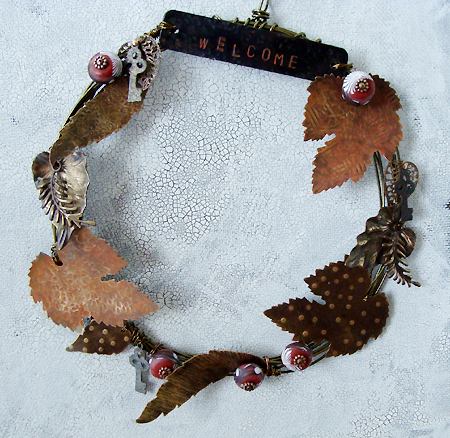
Best of the ABS: Autumn Wreath Tutorial

I created this wreath with wire, Vintaj components and art beads as a house-warming gift for a dear friend.  You could create a similar one to welcome your guests during your fall celebrations or as a special gift.  Another variation would be to stamp the family name of the recipient on the name plate instead of 'welcome' for a more personalized touch. 

Supplies:
4.5" 18 gauge brass color wire
11 3" lengths of 24 gauge brass color wire
5 polymer clay disk beads
1 arte metal name plate
3 brass maple leaves
2 brass slender leaves
2 brass woodland leaf pendants
2 brass fern charms
2 brass filigree leaf charms
1 brass trailing leaf
3 arte metal keys
5 6mm flat copper spacers
5 3" copper headpins
2 1" copper headpins
8" silk ribbon
Acrylic Paint Dabber
Renaissance wax
Steel wool

Tools: bench block, letter stamps, ball peen hammer, rivet hammer, Phillips head screw driver, brass texture plates, round and flat nose pliers, wire cutters.

Directions:
1.  Create the wreath by wrapping the wire into a large loop, approximately 5 1/2" wide.  Wrap the wire in into a large loop 9 times around.  Create a wrapped loop at the top of the wreath and wrap the ends of the wire around several times for a secure finish.


2.  Texture the leaves with the hammers, texture plates and screw driver. (Watch this video for several techniques.) Highlight the textures with the steel wool. 


3. Stamp "welcome" into the arte metal name plate with the letter stamps. Use the ball peen hammer to texture the blank. Use the acrylic dabber to add paint, rub off the excess with a paper towel. After the paint has dried rub a light coat of wax to protect the color. Paint two of the large leaves in the same way.

4. Place the leaf pendant on the bench block and strike the center with the round end of the ball peen hammer to shape the leaf in the concave form. Repeat with the other leaf and the two filigree leaves.


5. Attach the welcome name plate to the wreath by wrapping it the 24 gauge wire.

6. Attach the leaves to the wreath by wrapping them with the 24 gauge wire, securing them to the wreath. I found that wrapping the wire criss-cross over itself helps the leaves stay in place on the wreath. Layer some of the leaves together for an interesting texture. There is no right or wrong way to the attach the elements, whatever holds them most secure when wrapping the wire around the wreath will work. 

7. String a key and a filigree wreath onto a 1" headpin and from a loop. Attach to the wreath.


8. String a flat spacer and polymer clay disk bead unto a 3" headpin.  Attach the headpin to the wreath by wrapping it around the wire several times. 

9. Add the ribbon to the top loop on the wreath, tie a simple knot at the top of the ribbon.


Resources: Disk Beads, Humblebeads.  All brass and wire from Vintaj - retail at Bello Modo.  Silk Cord, Angela Brittain. Copper findings, Rings & Things.

Thursday, December 31, 2009

Best of the ABS - Create a Business Plan


Jennifer shared this post with us last January.  'Tis the season for planning, refocusing and setting goals, so I thought it would be a good one to share again today!

This is the time of year I start thinking about my goal and aspirations for the year. Personally, I am a big list maker and goal follower. I believe you have to know where you're going to get there. If you don't have a business plan, now is the time to make one. If you're thinking, how do I get started, what do I need to know, oh my gosh I just make jewelry to sell every now and then, do I need one of these? Yes you need one and the good news is they are not hard to write.

The best part is, it's your business, so you can make your business plan as complicated or as uncomplicated as you want. So what do you need in this plan? Here we go….

Define what you make and sell. Describe in depth what you make. Maybe you make custom jewelry, or just earrings, maybe children’s jewelry. If you know what you make, then you can stay focused on those products and keep you business heading in a consistent direction. Also make sure you think about your competition. Make sure you are making something different than everyone else.

Marketing: Marketing is how you will sell your work. Will you travel to shows, will you have home parties, will you advertise in magazines? These are all things to think about. Maybe you want to expand where you sell your work or add a few more shows this year. Here’s where you
would want to brainstorm and then refine your plan.

Operations: This is how you work. Is this a part time job where you will devoted ten hours a week or is this a full time job? Based on your hours, you will then need to create goals like three necklaces a day. This way you can work out your production schedule. You'll need to know you have enough time to make everything you will need to sell.

Finances: You will need to make financial goals. Even if this jewelry business is just for fun. You obviously want to succeed so you have to create sales goals and keep track of if you are achieving them. It really is the only way to know if you are charging enough and if you are on
track to meet your goals.

Once you have brainstormed about these categories, you can write a paragraph about each section. At this point you might just have enough to be done. However, it might not hurt to make it official. If down the road you ever want to borrow money to expand your business, your banker will want to see a plan. Another reason to have a written plan, when you're feeling unmotivated or lost you can pull it out and read it. It will immediately remind you what you want to achieve.

For more information, about writing a business plan, you can visit:
http://www.sba.gov/smallbusinessplanner/plan/writeabusinessplan/SERV_ESSENTIAL.html

Good luck following your goals in 2010!

Written by Jennifer Heynen of Jangles.

Wednesday, December 30, 2009

Best of the ABS - Throw a Bead Soup Party

This post first ran last May, but wouldn't a New Year's Day Bead Soup Party be the perfect way to celebrate the New Year?  Gather together a few beading buddies and make a batch of black eyed peas to serve for lunch!

Here are the basics to throw a little beady soiree of your own:

How to Throw a Bead Soup Party

1. Invite a few of your Beady Friends.

2. Each person needs to bring a strand of beads to share. (You can suggest a color scheme.)

All guest will also need to bring:
focal bead
spacer beads
clasp
beading wire
crimp beads
crimping pliers and wire cutters

3. When everyone arrives, dump the strands of beads into a large bowl. Divide the beads up randomly among your group.

4. String a memory necklace or bracelet using your bead soup.

*provide chocolate for best results!

Pictured above is a work in progress that I started at our last Bead Soup party. We went with a silver/grey/purple color scheme. You can use evite.com for simple online invitations. Don't have any beady friends? Invite a few gals over and teach them how to string!

Have any ideas for a bead party that you'd like to share? I'd love to hear them.

Tuesday, December 29, 2009

Best of the ABS - Transforming Inspiration into Design

This post first appeared last January in response to our challenge themes for 2009, which were all from art history. I shared some thoughts on my creative process of transforming a painting into a jewelry design.
Inspired by the movement of the brushstrokes, I want to create a design with movement and texture. I would use lampwork disks by Blue Seraphim in the colors of the painting, wire-wrapped with silver to show off their swirls. To emphasis the feeling of a garden, I'd pair them with leafy green freshwater pearls. To finish the design I'd return to the theme of abundant texture and use one of Mamacita Beadworks floral inspired buttons as a clasp.

Zoom in on a detail of a painting for unexpected results. Not every design inspired by Van Gogh's Irises need to have irises, blue or purple! By taking a corner of the painting that you find visual appealing, you can come up with a striking design that is a little off the beaten path. For this necklace I focused on the upper right corner of Van Gogh's painting to explore a design using those lush greens and sunny yellows. For this design I'd use a ceramic pendant and connectors in green from Chinook Jewelry. I'd connect them together with hammered silver links from Prolifique. On each link I'd add dangles of yellow crystals that remind me of the flowers in the painting.

While it's not necessary to take a literal approach to interpreting a masterpiece into a jewelry, you may find just the right bead for such a design. Lampwork artist Hannah Rachel offers sculpted iris beads that are made to order. Could there be a more perfect bead for this challenge? I'd make a tassel of pearls, crystals and stones in greens to create the "stem" of the iris. To carry on with the bold and organic theme I'd use peacock stick pearls mixed with silver beads. A handcrafted clasp from Cathy Dailey's shop would compliment the shape of the pearls and the earthy feel of the design.

Saturday, August 29, 2009

Best of the ABS: Recycle a Tomato Cage: Alternative Use of Art Beads

Recycling is gaining popularity. Most of us wouldn't think recycling and art beads go together but I created a garden sculpture doing just that in this 2007 ABS post....

I've been staring at an old tomato cage for a few months. It looked like a tree, it was asking me to make something from it. I had to think, though. I'm a rabid recycler but my weakness is that I ALWAYS think I can re-use something - even when it's broken beyond repair. But this tomato cage wouldn't let me send it to the curb. I finally figured out what it wanted to be - a beaded garden sculpture! I've been keeping those pretty beads that weren't saleable in a bowl in the studio. No one is allowed to take them - well, ok, maybe I've let a few kids take them - but they're just not up to the standards I have for saleable items. They're little pieces of art, though, and I just couldn't bear to put them into the glass garbage.

I think the beads whispered to the tomato cage - "let's work together." I know, I know, the beads don't talk and neither does the tomato cage, but sometimes art does have a way of speaking to us. Does it speak to you?

Thursday, June 25, 2009

Best of the ABS - I WILL Create!

Best of the ABS - Guest Blogger Gaea, first published 7/09/08

I will create. i WILL create. i will CREATE! Ever been stuck in a creative rut? With so many amazing techniques and materials out there it doesn't seem like you possibly could. But it happens. Forcing yourself into it almost never works. Recently I have found that inspiration comes in from some very unusual places and at unusual times.

Our T.V. for instance. It is an older model and has been prone to throwing fits of color tantrums. It will suddenly decide to throw out all colors but magenta. Which when watching a movie with highly saturated colors can make for some interesting schemes! I have a few designs planned with these colors in mind. Nature has a plethora of inspiration. Ocean colors and shapes. Forest colors and shapes. Sky colors and shapes. I find it fun to mix them up and put them together. Here is a fun exercise to get your creativity going on a different track if you feel stuck in a rut...

Write various colors, shapes, textures and materials onto strips of paper put them in the old hat and pull out three or four. It could be a fun jumping off point for some serious design! Sometimes if I feel like I need a push into unfamiliar territory I will sketch or draw a few ideas. Sometimes, as much as we love our first ideas, they may be a bit off the mark but playing with an idea can sometimes produce something that does hit mark. Play! See what happens!


The colors and style of this bracelet were inspired by the movie "The Darjeeling Limited" while our T.V. was on the fritz!


The vibrant blue and green hues in "My Neighbor Totoro" were the inspiration for these charms.


A friends beautiful "Day of the Dead" fabric was the thought for this one.

Written by guest editor, Gaea. Visit her website to see more of her amazing creations and her blog to catch up on what's new in the studio.

Wednesday, December 31, 2008

Best of the ABS - Goals/Resolutions

At the beginning of this year, former ABS editor Elaine Ray shared her goals with us for some New Year's inspiration. As you prepare for tonight's festivities here is her post again as you think of what you'd like to accomplish in 2009.

Who out there has New Year's resolutions / goals? As I reviewed last year's beading list it came to my attention that every idea checked off as "completed" was accompanied by specific "to-do" steps. So this year, I'm setting only goals with "how to" steps - no general resolutions. My "resolve" to do-what-needs-to-be-done seems somewhat weak, but give me a written out goal that I can then cross off the list and I'm on it. I love tools and my tools right now are a list and a Sharpie!

So now I present you with a few of my beading goals and the steps for achieving these goals:

1) Keep up with paper work.
a) Place a sticky notepad by my bed so I can jot down notes as I get ready for bed. In the past I just kept one notebook in my studio, but could never seem to make myself go back downstairs to write in it if I had neglected to do so earlier in the day. I'd just tell myself "I'll write it down in the morning." Yeah, you can guess how good that worked out. So now I'll be able to just grab that sticky note and plop it into my actual notebook the next morning.
b) Put a sticky notepad in my car and one in my purse.
c) Get rid of that place where I put things to file later and just file them now, later never seems to get here.

2) Design and post a entry for each month of the Art Bead Scene challenge. (I know, this should be especially easy for me as I get to know the challenge even before the month begins!) As I set about laying out the steps to achieve this goal I realized that my block has to do with my beading space / organization. So my real goal here is to "Set up and maintain an area for jewelry making". Which, in my case, if very different than the area where I make bead and pendants.
a) Organize beads, pendants, findings, yarn, wire and tools.
b) Hang cork board.
c) Get a sketch book and use it. No more scrapes of paper all over the place.
d) Do not use my beading desk as a "catch all" place for my home life - this is work space. I'm very protective of my clay working space, why not be with my beading space?
e) When trying out different designs, take a quick digital photo of one arrangement before trying the next arrangement - my memory is not what it used to be. Keep digital camera handy - no lost time looking for it, its battery, cables or whatever.

3) List one item on Etsy per week. (This goal is also tied to the above goal.)
a) Read up on Etsy, but don't delay listing: I don't have to know everything before getting started.
b) Designate a place to store items listed in a manner where they can be easily packed up and shipped when sold.

4) Get new styles of beads and pendants out there for the public to see.
a) Maintain my own blog better. (I know this sound more like a resolution than a goal - I did write out steps to achieve this but they are too boring for here.)
b) Improve Elaineray.com (Same as above.)
c) Post entries on Art Bead Scene.
d) List on Etsy.
e) Visit and leave comments on designer blogs / web sites.
f) Send digital images / samples to bead shops.
g) Always take the time to photo new items.

5) Set up a somewhere to take quick, reliable photos. They don't have to be jury ready quality, just get the picture taken.

6) Get a business card and carry a few with me at all times. Never hesitate to give one out.

As I read through this list, I realize how fast I should be able to get the steps done, freeing me up to accomplish the actual goals throughout the year. To realize that I really do need to stop and think about what is getting in my way of accomplishing my goals has been a good exercise. Being an Occupational Therapist by training, I should have realized this - no one does Activity Analysis like an OT!

If you'd like another perspective, additional ideas and support to write or revise your own goals, here is link to a great article written by our favorite Bead Nerd, Lori Greenberg.

Thanks for letting me think out loud here with you. Everyone has different ways of approaching goals and getting the job done. Leave us a comment with your own ways of organizing / goal setting for your beady businesses and we can all learn from each other. Feel free to leave a link to your own list of goals / resolutions.

Tuesday, December 30, 2008

Best of the ABS - Ribbon

I'm still loving ribbon as much as I did when this post was first published back on October 31st.

I've seen an influx of ribbon related clothing and accessories this month. I like the versatility of ribbon, you can use them in alter art/mixed media jewelry pieces, vintage, steampunk or Victorian inspired designs, or you can use ribbons for a modern twist.
You can entwine ribbon in metal chains, use as a cord with a focal bead, embellish a ribbon choker with a pendant, use a ribbon as a closure or tie little bits of ribbon in between beads for some added texture.

A very modern design by Lorelei Eurto combining a Humblebeads spacer bead with wood, glass, stone, brass and a rich chocolate ribbon closure.

Smoky gray seam binding from WistfulSupplies.


A cuff bracelet by MJM Jewelry Designs using another Humblebeads spacer with silk ribbons.

Hand dyed silk ribbon from Jamnglass.


Raku pendant with silk ribbon by MAKUstudio.


Hand dyed ribbon from JodyPoesy.

Here are some more art bead and ribbon designs that have been entered in the Art Bead Scene Flickr group for various challenges.

Ribbon ideas from Beading Daily

And a few designers who offer inspiring creations with ribbons in their jewelry:

Nina Bagley - Narrative/altered art jewelry

Raven Eve Jewelry - Victorian inspired designs

Gilded Cage Design - Ribbon and button jewelry

I'd love to see your designs using art beads and ribbon. Leave a link in the comments if you'd like to share.